
The evidence is clear: the first 30 days of a new technician's employment dictate their entire future at your company. Home service businesses—from HVAC to pest control—bleed revenue every time a new hire ghosts on day three or quits in week two. Implementing structured onboarding best practices is not a luxury; it is a critical operational mandate.
According to Gallup's research on employee onboarding, only 12% of employees strongly agree their organization does a great job onboarding new hires. This failure rate is catastrophic for local service businesses that rely on skilled labor to drive revenue. When you lose a technician, you lose the revenue they would have generated, the money spent acquiring them, and the time wasted by your management team.
This comprehensive guide breaks down the exact onboarding best practices you must deploy to secure top talent, accelerate time-to-productivity—the duration it takes for a new hire to contribute positively to your bottom line—and permanently eliminate early-stage turnover using AI-driven automation.
The True Cost of Broken Onboarding

The financial impact of a disorganized onboarding process is demonstrably massive. Owners of home service businesses often underestimate the hidden costs of losing a new hire.
Data shows that the average cost per hire is nearly $4,700, according to SHRM's latest benchmarking data. However, in highly specialized fields like HVAC, roofing, and pest control, this number often doubles when factoring in lost truck rolls and delayed service calls. Furthermore, the Bureau of Labor Statistics data on occupational turnover confirms that construction and extraction occupations experience annual turnover rates exceeding 50%.
Therefore, fixing your onboarding process is the fastest way to increase your profit margins.
mermaid pie title Hidden Costs of a Failed Technician Hire "Lost Revenue (Unassigned Calls)" : 45 "Recruiting & Advertising Spend" : 25 "Management Time Wasted" : 20 "Training Materials & Uniforms" : 10
When a new hire arrives on day one to find no uniform, a disorganized schedule, and a mountain of paperwork, they immediately question their decision to join your company. 'Onboarding is a magic moment when new employees decide to stay engaged or become disengaged,' states Amy Hirsh Robinson, Principal at The Interchange Group. You must capture this magic moment with precision.
Why Traditional ATS Fails at Onboarding
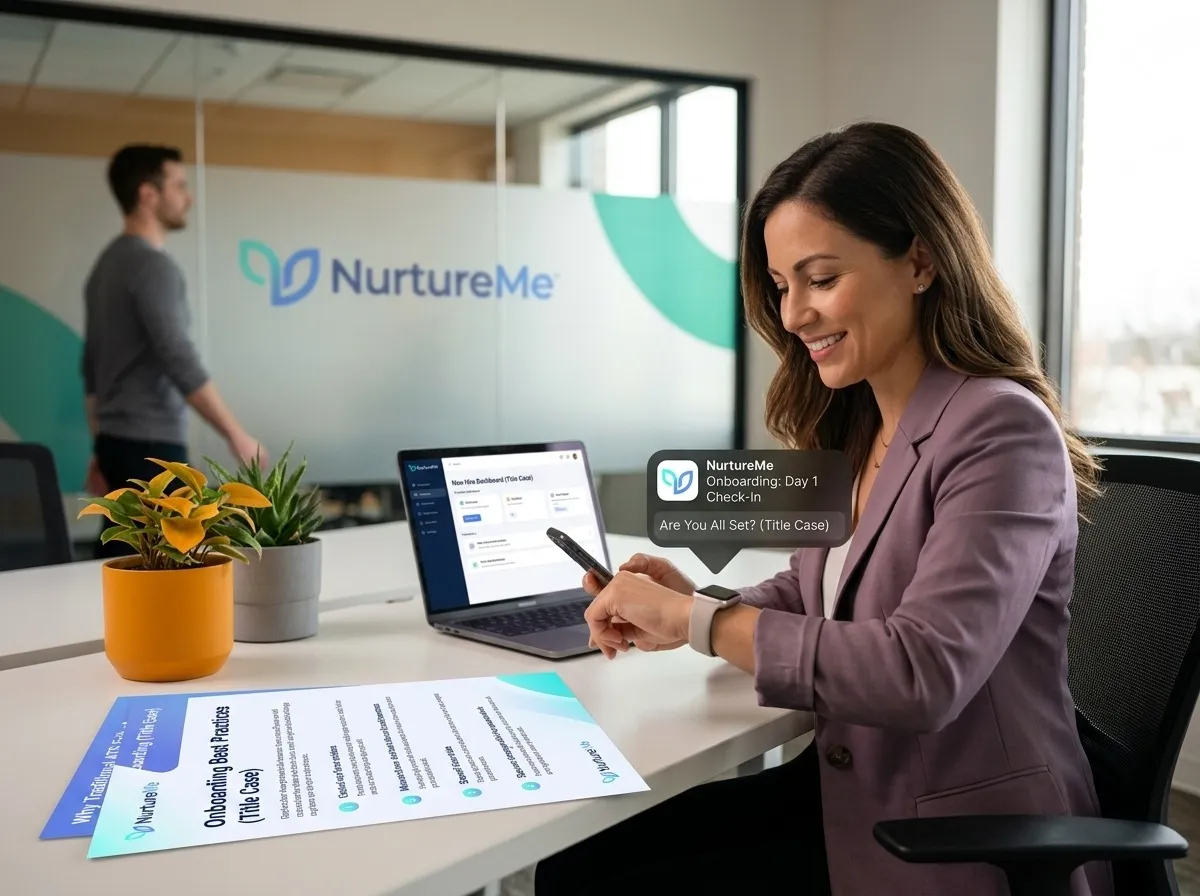
Most companies attempt to solve their hiring problems using a legacy Applicant Tracking System (ATS)—a software application that enables the electronic handling of recruitment needs. Platforms like Workable or Greenhouse are built for corporate desk jobs, not field services.
Specifically, traditional systems stop working the moment the offer letter is signed. They treat hiring and onboarding as two entirely separate functions. In contrast, NurtureMe treats the employee lifecycle as a single, continuous pipeline.
Consequently, relying on a traditional ATS guarantees that your new hires will fall into the 'post-offer void'—the silent period between accepting a job and their first day, which is when 65% of candidate ghosting occurs.
7 Proven Onboarding Best Practices for 2026

To achieve 90% retention rates and scale your operations, you must implement these seven onboarding best practices immediately.
1. Automate the Pre-Boarding Phase
Pre-boarding is the communication that happens before day one. It is critical for preventing no-shows. Data shows that candidates who receive regular communication before their start date are 83% more likely to show up.
Instead of relying on an HR manager to remember to send emails, use AI to automate this. With NurtureMe, our AI agent Stella texts the candidate welcoming them to the team, sends them a link to order their uniform sizes, and provides a clear itinerary for their first day. This eliminates anxiety and builds immediate loyalty.
2. Implement Role-Specific Training Pathways
A generic onboarding manual is useless for a pest control route runner. You must create highly specific, role-based training pathways.
For example, when you leverage our HVAC Technician Recruiting tools, the system automatically assigns the new hire to the HVAC-specific onboarding track. This track includes safety compliance videos, tool checklist verifications, and ride-along schedules with senior technicians. Personalization accelerates time-to-productivity by ensuring the technician only learns what they actually need to perform their job.
3. Integrate Payroll Seamlessly on Day One
Nothing destroys a new employee's trust faster than a delayed first paycheck. Manual data entry from paper forms into your payroll system is prone to human error and delays.
By utilizing Automated Onboarding & Payroll, new hires complete their W-4s, I-9s, and direct deposit information digitally via their smartphone before they ever step foot in the office. The data flows directly into your payroll system seamlessly. This ensures compliance and guarantees accurate, on-time payments.
4. Leverage Gamification for Early Engagement
Field service work can be isolating. Technicians spend most of their day alone in a truck. Therefore, building culture early is essential.
Introduce gamification during the onboarding process. Award points for completing training modules early, passing safety quizzes, or receiving a positive review from their ride-along mentor. Our Culture & Retention Tools include digital leaderboards that allow new hires to see how they stack up against their peers, fostering healthy competition and deep engagement from week one.
5. Schedule Mandatory 30-60-90 Day Check-Ins
Onboarding does not end on Friday of week one. A 2023 analysis by Harvard Business Review confirms that organizations with a standard, extended onboarding process experience 50% greater new-hire retention.
Set automated calendar reminders for managers to conduct structured check-ins at the 30, 60, and 90-day marks. These meetings should not be informal chats; they must be structured reviews of key performance indicators (KPIs), tool audits, and cultural alignment checks.
6. Utilize AI-Driven Turnover Prediction
What if you could know a technician was going to quit before they actually handed in their notice? Advanced AI platforms now offer predictive analytics based on employee behavior.
If a new hire stops logging into the training portal, starts arriving late to dispatch, or shows a drop in customer satisfaction scores, the AI flags them as a flight risk. This allows operations managers to intervene early, address the root cause of the frustration, and save the employee before the investment is lost.
7. Connect Hiring to Revenue Impact
Ultimately, onboarding must be tied to business growth. You are not hiring people just to have a larger headcount; you are hiring them to run more routes and close more sales.
Track how quickly a new cohort of hires reaches full revenue-generating capacity. If your January onboarding class takes 45 days to run solo routes, but your automated March class takes only 21 days, you have demonstrably increased your company's earning potential.
Scenario Deep Dive: The Perfect HVAC Technician Onboarding
To truly understand the power of these onboarding best practices, let us examine a detailed scenario.
Meet John. John is a licensed HVAC technician with three years of experience. He is exactly the type of candidate your business desperately needs. He applies for your open position on a Tuesday evening.
Phase 1: The AI Interview (Days 1-2) Within five minutes of applying, Mia—NurtureMe's AI Interviewer—texts John to schedule a phone screen. Mia conducts a 15-minute voice interview, verifying his EPA certifications, driving record, and availability. Mia ranks John as a top candidate and automatically schedules an in-person interview with your operations manager for Thursday.
Phase 2: The Offer and Pre-Boarding (Days 3-7) John aces the in-person interview. You extend an offer via the NurtureMe platform. John signs the digital offer letter on his phone. Immediately, the pre-boarding sequence triggers. Stella texts John a welcome video from the owner. Over the weekend, Stella sends John a link to complete his tax forms and order his size Large company polo. John feels incredibly valued before he even starts.
Phase 3: Day One and Beyond (Days 8-90) John arrives on Monday. His uniform is waiting on his desk. His iPad is already provisioned with the routing software. Because his paperwork was handled via AI, he spends zero time in the HR office. Instead, he immediately begins his ride-along with a senior tech. Over the next 90 days, the system automatically pings John with micro-training quizzes and prompts his manager to conduct performance reviews.
As a result of this flawless execution, John reaches full productivity in just 14 days, generating immediate ROI for the business.
The Bottom Line on Retention
Stop burning money on job boards only to lose candidates to poor onboarding. The home services industry is highly competitive, and technicians have endless options. If your onboarding process is chaotic, they will demonstrably leave for a competitor who has their operations in order.
By implementing these onboarding best practices and leveraging purpose-built AI tools, you can cut your cost-per-hire by 90%, reduce time-to-hire to days, and completely eliminate candidate ghosting.
Our platform has successfully completed over 40,000+ hires, unlocking $50M+ in revenue for local service businesses while maintaining 90% retention rates. The data proves that automated, highly structured onboarding is the key to scaling your operations profitably.
Frequently Asked Questions
What is the most important onboarding best practice for home service businesses?
The most critical practice is automating the pre-boarding phase. Communicating consistently between the offer acceptance and day one prevents candidate ghosting and ensures compliance paperwork is completed before training begins.
How does AI improve the employee onboarding process?
AI improves onboarding by automating repetitive administrative tasks. AI agents can send SMS reminders for paperwork, sync data directly to payroll, assign role-specific training modules, and predict early turnover risks based on engagement data.
Why do traditional Applicant Tracking Systems (ATS) fail at onboarding?
Traditional ATS platforms are designed primarily for corporate recruiting and stop functioning once an offer is signed. They lack the specialized workflows, SMS communication tools, and payroll integrations required to successfully onboard field service technicians.
.png)