The home services industry is facing a massive operational bottleneck. If you run a pest control, HVAC, or roofing business, you know the acute pain of empty trucks and unfulfilled service calls. The root cause of stagnant growth is rarely a lack of customer demand. Instead, the problem lies entirely in outdated, manual hiring practices.
To fix this, modern operators are turning to recruiting analytics. By leveraging hard data, you can stop guessing, eliminate emotional hiring decisions, and start building a predictable, highly profitable talent pipeline.
The Staggering Cost of Hiring Blind
The evidence is clear: relying on gut instinct to hire field technicians destroys profit margins. Traditional job boards like Indeed or ZipRecruiter charge premium prices for unqualified leads, resulting in a chaotic and expensive hiring process.
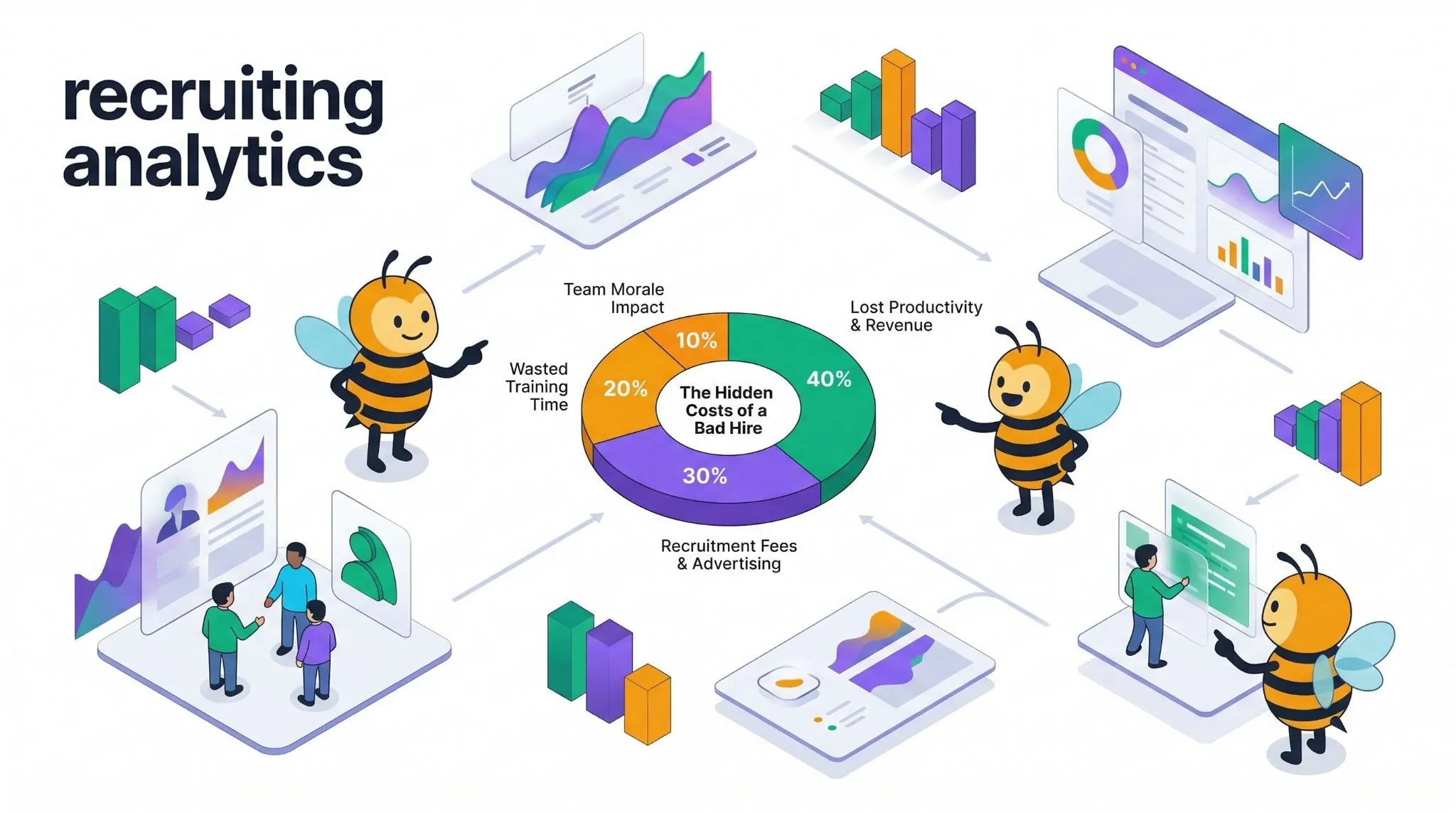
According to the U.S. Department of Labor (2025), a bad hire costs a business at least 30% of the employee's first-year earnings (execsallied.com). For a specialized HVAC technician earning $60,000, that represents an $18,000 mistake right out of the gate. Furthermore, the construction and trades sector suffers from a baseline turnover rate of 20% to 30% annually, with some firms experiencing turnover as high as 57% (HH2, 2025).
Consequently, high turnover combined with expensive hiring mistakes creates a financial sinkhole. You demonstrably lose money every single day a service route goes unstaffed.
"Business speaks the language of data," says Kyle Lagunas, talent strategist and founder of Kyle & Co., in a 2025 SHRM report. "For recruiting to not speak that language is a major credibility gap."
The Epidemic of Candidate Ghosting
Beyond the cost of a bad hire, home service businesses face the epidemic of candidate ghosting. Ghosting occurs when an applicant simply stops responding to calls, emails, or interview invitations.
In a highly competitive local market, technicians have options. If your hiring process is slow, clunky, or requires them to fill out a 45-minute online application, they will abandon the process. They will simply go work for the competitor down the street who texted them back in five minutes.
Specifically, the average Time-to-Hire — the exact number of days from application to an accepted offer — currently sits at 44 days in the U.S. market (high5test.com). In the fast-paced home services sector, waiting six weeks to put a technician in a truck is a death sentence for revenue growth. If you cannot track where these candidates are dropping off, you cannot fix the leak in your funnel.
Why Traditional ATS Platforms Fail Home Services
Many owners attempt to solve this problem by purchasing a traditional Applicant Tracking System (ATS). However, this software only treats the symptom, not the disease.
Think of a traditional ATS like a digital filing cabinet. It stores PDF resumes perfectly, but it does absolutely nothing to actively find, engage, or screen candidates. Your HR managers are still forced to manually review applications, chase down candidates who ghost interviews, and build complex spreadsheets to track performance.
When you lack a proper Recruitment Reporting & Analytics system, you cannot identify operational bottlenecks. Therefore, you continue pouring marketing dollars into the top of a fundamentally broken funnel. Traditional ATS platforms are built for corporate desk jobs, not for the high-volume, high-velocity demands of field services.
The Solution: AI-Powered Recruiting Analytics
The permanent fix is transitioning from manual tracking to automated intelligence. A modern hiring metrics dashboard does more than display past data; it actively improves future outcomes.
A 2025 report by the Society for Human Resource Management (SHRM) found that 51% of organizations now use AI specifically for recruiting (shrm.org). More importantly, the data shows that AI-powered recruitment systems reduce time-to-hire by an average of 40%.
This is exactly where NurtureMe changes the game. NurtureMe is not just a passive storage system; it is an active, AI-powered hiring platform built specifically for home services. By integrating advanced analytics with autonomous AI agents, NurtureMe cuts cost-per-hire by 90% and reduces time-to-hire to mere days.
Meet Your Autonomous AI Hiring Team
To understand how this ecosystem works, you must look at the specific AI agents driving the platform. Each agent handles a distinct phase of the pipeline, generating clean, actionable data for your recruitment reporting tool.
1. Friendzy (The Sourcing Agent)
Before you even pay for an expensive job board post, Friendzy goes to work. This agent uses gamification and AI targeting to source high-quality candidates passively. By engaging talent before they actively start looking for jobs, Friendzy drops your Cost-per-Lead — the marketing spend required to acquire one applicant — to under $1. This is a massive reduction compared to the $100+ you might spend elsewhere. Learn more about Friendzy Candidate Sourcing.
2. Ava (The Screening Agent)
When hundreds of resumes flood in, human fatigue sets in. Ava instantly reads and comprehends 500+ resumes in seconds. She uses Predictive Analytics — historical data modeling used to forecast success — to surface the top 10 candidates you should actually interview. She strips away the noise and ensures you only see top-tier talent.
3. Stella (The Outreach Agent)
Stella handles all candidate communication. She texts and calls candidates relentlessly, ensuring zero drop-off. If a candidate is qualified, Stella schedules them directly onto your calendar. Because Stella operates 24/7, candidates receive immediate responses, effectively eliminating the ghosting problem.
4. Mia (The Interviewing Agent)
Mia conducts the first-round phone screens. She asks technical, trade-specific questions, ensuring you only spend your valuable time speaking with fully vetted professionals. Mia grades the responses, updates the analytics dashboard, and moves the best candidates to the final human interview stage.
NurtureMe vs. The Traditional ATS
To clearly illustrate the difference, consider how NurtureMe stacks up against generic software in the market today.
As the table demonstrably proves, NurtureMe replaces manual labor with intelligent automation. You get full visibility into your hiring funnel without doing the heavy lifting.
7 Key Metrics You Must Track in 2026
If you want to scale your business from $5M to $50M, you must track the right numbers. A robust recruitment reporting tool should monitor these seven critical KPIs:
1. Time-to-Hire As defined earlier, this is the total days from application to accepted offer. A high time-to-hire means your competitors are stealing your best candidates. Stella drastically improves this metric by eliminating back-and-forth scheduling delays.
2. Cost-per-Hire This is the total financial investment required to seat a new employee. It includes job board fees, software costs, and the hourly rate of your HR staff. By leveraging Automated Outreach & Recruiting, NurtureMe slashes this metric by up to 90%.
3. Pipeline Velocity Pipeline velocity measures how fast a candidate moves from one stage to the next. If candidates stall in the "Screening" phase for four days, your velocity is too slow. Ava ensures resumes are screened in seconds, keeping velocity at maximum speed.
4. Interview-to-Offer Ratio This is the percentage of interviewed candidates who actually receive a job offer. If you interview 20 people to make 1 hire, your ratio is 5%, which indicates a massive waste of management time. Mia ensures this number stays high by filtering out unqualified applicants early.
5. Quality of Hire This metric tracks the performance and cultural fit of a new employee after 90 days. It is the ultimate indicator of recruiting success. AI models learn from your best employees and actively seek out similar traits in new applicants.
6. Source of Hire Which channel brings you the best technicians? Is it Indeed, employee referrals, or direct sourcing? Tracking this allows you to double down on profitable channels and cut spending on platforms that only deliver low-quality leads.
7. First-Year Retention Rate The percentage of new hires who stay beyond 12 months. Hiring is useless if the employee quits in three weeks. NurtureMe's integrated culture and gamification tools help maintain an industry-leading 90% retention rate.
How to Implement AI Recruiting in 30 Days
Transitioning to AI-driven recruiting analytics does not require a six-month IT project. You can modernize your hiring process in just 30 days by following these steps:
Step 1: Audit Your Current Spend Calculate exactly how much you spent on job boards last year. Divide that number by your total hires. This gives you a baseline Cost-per-Hire to measure against.
Step 2: Deploy the Sourcing Agent Turn on Friendzy to begin building a proprietary talent pool. Stop renting access to candidates on public job boards and start owning your candidate data.
Step 3: Automate the Outreach Connect Stella to your calendar. Let the AI handle the tedious work of texting candidates and booking interview slots. This immediately reclaims 15-20 hours a week for your HR manager.
Step 4: Review the Analytics At the end of the month, open your hiring metrics dashboard. Review your pipeline velocity and interview-to-offer ratio. Make data-driven adjustments based on hard evidence, not intuition.
The Undeniable Proof
The results of implementing AI-driven recruiting analytics speak for themselves. NurtureMe has successfully completed over 40,000+ hires for its partners across the United States and Canada. By keeping service trucks fully staffed with top-tier talent, the platform has unlocked over $50M+ in revenue for local service businesses.
Furthermore, companies utilizing the platform consistently see client growth rates between 148% and 200%. When you eliminate the operational bottleneck of hiring, your business is finally free to scale aggressively.
In conclusion, the days of relying on hope and manual spreadsheets are over. The evidence is clear: businesses that adopt AI recruiting dominate their local markets. Stop burning money on dead-end job boards, eliminate candidate ghosting, and start making data-driven decisions today.
Sources & References
- Recruiting 101: The True Cost of a Bad Hire — Executive Alliance (2025).
- Recruiters Express Optimism for 2025 — Society for Human Resource Management (2025).
- The Real Cost of Construction Employee Turnover in 2025 — HH2 (2025).
- 25+ Crucial Job Interview Statistics in the US — High5Test (2025).
Frequently Asked Questions
What are recruiting analytics?
Recruiting analytics involve using data and software to track, measure, and optimize the hiring process. This includes tracking metrics like time-to-hire, cost-per-hire, and candidate pipeline velocity to make informed business decisions.
How does AI reduce time-to-hire?
AI reduces time-to-hire by automating manual, time-consuming tasks. For example, NurtureMe's AI agents instantly screen resumes, conduct automated text outreach, and schedule interviews 24/7 without human intervention.
Why is turnover so high in home services?
Turnover is high due to burnout, poor cultural fit, and misaligned expectations during the initial hiring process. Using predictive analytics helps ensure you hire candidates who possess the right skills and are statistically more likely to stay long-term.
.png)