
The home services industry is facing an unprecedented staffing crisis. Profit margins are tight, consumer demand is consistently high, and skilled labor is increasingly scarce. Consequently, business owners and operations managers are constantly asking how to reduce cost per hire without sacrificing the quality of their technicians.
The traditional playbook relies on posting generic descriptions to expensive job boards, waiting for applications, and praying for qualified candidates. This approach demonstrably fails. According to a 2024 report by the Society for Human Resource Management, the average expense to bring on a new employee has skyrocketed to $4,700 across all industries (SHRM's talent acquisition benchmarking data). For specialized home service roles like HVAC technicians, plumbers, or pest control specialists, that number often doubles due to intense local competition and prolonged vacancy periods.
To survive and scale, modern home service businesses must abandon legacy methods. The evidence is clear: artificial intelligence hiring is no longer a futuristic concept. It is the baseline requirement for profitability.
The Problem: The Hidden Math Behind Your Hiring Costs
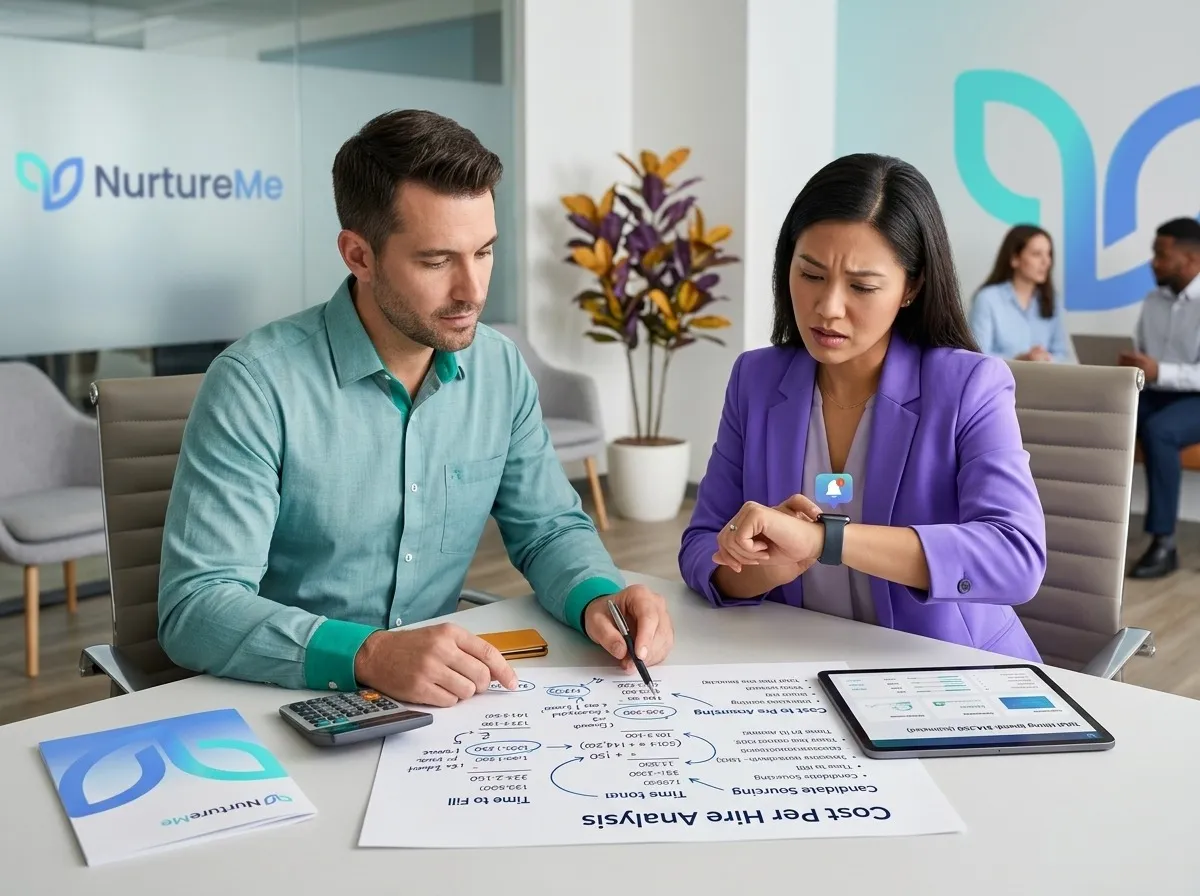
Before you can optimize your recruitment budget, you must understand exactly where your money is bleeding out. Most founders only look at external costs, such as the monthly invoice from Indeed or ZipRecruiter. However, the true financial drain lies in the internal operational drag.
Cost per hire is calculated using a simple formula: (Total Internal Recruiting Costs + Total External Recruiting Costs) / Total Number of Hires.
Let's break down why this number inflates so rapidly for local service businesses:
- External Costs: These include job board postings, background checks, drug screenings, and external recruitment agency fees. When you pay $100+ per post on traditional boards, you are paying for visibility, not guaranteed quality.
- Internal Costs: This is the silent killer. It includes the hourly rate of your HR manager reviewing 500 unqualified resumes, the time your operations manager spends conducting phone screens with candidates who lack basic certifications, and the administrative burden of scheduling interviews.
- The Cost of Vacancy: Every day a service truck sits empty, your business loses money. A single unstaffed HVAC or plumbing truck can cost a company $1,500 to $3,000 per day in uncaptured revenue.
Furthermore, the long-term cost of making a poor hiring decision is devastating. According to the U.S. Department of Labor (2023), the financial impact of a bad hire is approximately 30% of their first-year earnings (Department of Labor resources). If you hire an underqualified technician for $60,000, replacing them will cost your business roughly $18,000 in lost productivity, onboarding time, and repeated recruitment efforts.
The Agitation: Ghosting and Legacy Software
Compounding these financial losses is the modern phenomenon of candidate 'ghosting'—where applicants simply stop responding to messages or fail to show up for scheduled interviews. When a human recruiter is managing 50 candidates manually, follow-ups slip through the cracks. Candidates find other jobs while your HR team is busy doing administrative paperwork.
Many businesses attempt to solve this by purchasing a traditional Applicant Tracking System (ATS). However, platforms like Workable or Greenhouse merely act as digital filing cabinets. They store candidate data, but they do not actively do the work.
The Solution: Deploying AI in Recruiting

To drastically cut staffing expenditures, you must automate the manual labor associated with talent acquisition. This is where AI in recruiting fundamentally changes the unit economics of your business.
By deploying specialized AI agents, you can compress a 42-day hiring cycle into just a few days. NurtureMe achieves this through a coordinated team of artificial intelligence agents that work 24/7 without fatigue, bias, or the need for a salary.
Step 1: Sourcing with Friendzy
The first step to reducing costs is lowering your Cost Per Lead (CPL). Traditional job boards charge a premium because they own the candidate traffic.
NurtureMe utilizes Friendzy—a proprietary sourcing engine that finds high-quality candidates before they ever hit expensive job boards. Using advanced AI targeting and gamification, Friendzy engages passive candidates on social platforms and local networks. This method demonstrably reduces the cost per candidate lead to under $1, compared to the $100+ you would spend on legacy platforms.
Step 2: Instant Screening with Ava
Once applications flow in, human review becomes the bottleneck. An HR manager can only read so many resumes per hour.
Ava, NurtureMe's AI Resume Screener, utilizes Natural Language Processing (NLP)—a branch of AI that allows computers to comprehend and analyze human text—to read 500+ resumes in seconds. Ava does not just look for keywords; she understands context. She surfaces the top 10 candidates who actually possess the required licenses, driving records, and field experience you need.
Step 3: Relentless Outreach with Stella
Speed to lead is critical. The best technicians are hired within 48 hours of entering the job market.
Stella handles your Automated Outreach & Recruiting. Stella texts and calls candidates immediately upon application. She answers their basic questions about pay and hours, and she relentlessly follows up. Because Stella is an AI, she never gets tired, she never forgets to send a follow-up text, and she completely eliminates candidate ghosting by keeping applicants constantly engaged.
Step 4: First-Round Interviews with Mia
Phone screens are the most time-consuming phase of recruitment. Operations managers hate doing them, and they often waste hours talking to candidates who are completely wrong for the culture.
Mia, NurtureMe's AI Interviewer & Hiring agent, conducts all of your first-round phone screens. Mia engages in natural, two-way conversational dialogue with the candidate. She assesses their communication skills, verifies their technical background, and evaluates their cultural fit. You are provided with a complete transcript and a summarized recommendation. Therefore, you only spend your valuable time meeting the absolute best candidates in person.
The Proof: Real-World ROI and Data

The adoption of artificial intelligence in the hiring process is not an experiment; it is a proven operational upgrade. A 2023 report on artificial intelligence adoption found that organizations leveraging AI tools experience a massive reduction in operational overhead while simultaneously improving output quality (McKinsey report on AI in HR).
For home service businesses specifically, the data is undeniable. Companies utilizing NurtureMe's platform have collectively completed over 40,000+ hires. By ensuring that service trucks are staffed faster and with better talent, these businesses have unlocked over $50,000,000 in previously lost revenue.
'The companies that adopt AI recruiting first will dominate their local markets,' says Dr. John Sullivan, an internationally recognized HR thought leader and professor at San Francisco State University. 'Those who cling to manual resume reviews and generic job boards will simply be outpaced by competitors who can hire top talent in days, not weeks.'
Breaking Down the 90% Cost Reduction
How exactly does NurtureMe achieve a 90% reduction in cost-per-hire? It is a matter of eliminating redundancies:
- Zero Job Board Dependency: Friendzy replaces $2,000/month Indeed budgets with targeted, gamified sourcing.
- Zero Administrative Waste: Ava and Stella replace the need for a full-time administrative assistant dedicated to scheduling and resume sorting.
- Zero Wasted Manager Time: Mia ensures that your $100,000/year Operations Manager only spends time interviewing pre-vetted, highly qualified finalists.
mermaid pie title "Where Your Hiring Budget Goes (Traditional vs AI)" "Job Board Fees" : 40 "HR Admin Time" : 35 "Manager Interview Time" : 20 "Actual Onboarding" : 5
Future-Proofing: Retention and Forecasting
Reducing the initial cost to hire is only half the battle. To maximize your ROI, you must keep the technicians you hire. High turnover destroys profitability.
NurtureMe extends beyond the initial hire. The platform utilizes predictive analytics to align your hiring needs with your actual business revenue. By analyzing your sales data and seasonal trends, NurtureMe forecasts exactly when you need to start hiring for the summer HVAC rush or the spring pest control season. According to the Bureau of Labor Statistics (2025), demand for HVAC technicians alone is projected to grow 6% through 2032, meaning competition for this talent will only intensify (BLS Occupational Outlook).
Furthermore, NurtureMe includes built-in engagement tracking, gamified leaderboards, and automated pulse surveys. These tools monitor employee satisfaction and use AI to predict which technicians might be at risk of quitting. By addressing concerns before a resignation occurs, NurtureMe clients maintain an astonishing 90% retention rate, virtually eliminating the replacement costs that plague the industry.
Conclusion
Learning how to reduce cost per hire is no longer about negotiating cheaper rates with job boards. It is about fundamentally changing how the work of recruiting gets done. By implementing artificial intelligence companies hiring processes are transformed from a slow, expensive administrative burden into a streamlined, automated revenue driver.
Stop paying humans to do robotic work. Let Ava, Stella, and Mia handle the heavy lifting, so you can focus on scaling your home services empire.
Sources & References
- Real Costs of Recruitment — Society for Human Resource Management (2024).
- Heating, Air Conditioning, and Refrigeration Mechanics and Installers — Bureau of Labor Statistics (2025).
- The State of AI in 2023: Generative AI's Breakout Year — McKinsey & Company (2023).
- Employer Costs for Employee Compensation — U.S. Department of Labor (2023).
Frequently Asked Questions
What is the average cost per hire in the home services industry?
According to SHRM, the baseline average cost per hire across industries is $4,700. However, for specialized home service roles like HVAC or plumbing, this cost often doubles due to high competition, extended vacancy periods, and the lost revenue of unstaffed service trucks.
How does AI reduce the cost per hire?
AI reduces costs by automating the most expensive and time-consuming parts of the recruiting funnel. AI agents source candidates for under $1 per lead, screen hundreds of resumes instantly, handle all SMS/call outreach to prevent ghosting, and conduct first-round phone interviews. This eliminates the need for expensive job boards and heavy HR administrative hours.
Can artificial intelligence really conduct a job interview?
Yes. NurtureMe's AI Interviewer, Mia, uses advanced conversational AI to conduct natural, two-way phone screens. She asks technical questions, evaluates communication skills, and provides a full transcript and summary to the hiring manager, ensuring humans only spend time with top-tier candidates.
How does NurtureMe compare to a traditional ATS like Workable or Greenhouse?
Traditional ATS platforms are passive databases that require human recruiters to do all the manual work of emailing, calling, and scheduling. NurtureMe is an active AI platform featuring specialized agents (Ava, Stella, Mia) that actually perform the recruiting work for you, specifically optimized for the home services sector.
.png)